
Right place, right time; 100 years at Summer Hill
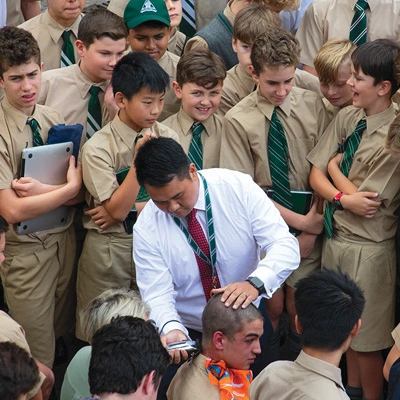
2026 marks 100 years since students and staff of Trinity Grammar School officially moved onto the Summer Hill site, where the School remains today. The move, back in 1926, can only be described as chaotic, but through the mishaps and frustrations, leadership led with clear eyes, trust in God’s plan, and a vision of the future that is now realised.
As this article is published, the end is in sight for the current phase of the Renewal Project, with new developments expected to be ready for the start of the 2027 School year. While the Project has moved at a cracking pace and progressed as planned, it hasn’t been without its disruptions to staff and students.
Those who were in Year 12 when this phase of the Renewal Project began in 2023 experienced these small disruptions, knowing that they personally would not benefit from the outcome. It’s these small sacrifices that every person in the Trinity community has made, knowing that it’s all for the greater purpose of providing enhanced facilities for generations of Trinity students to come.
Of course, the Renewal Project is not the first time Trinity has undertaken major works, or gone through a huge transformation.
Step back in time to the 1920s
Across much of the world, the 1920s are fixed in memory as a time of decadence, innovation and joy. In the wake of the first World War, things were finally looking up again and the rapid development of infrastructure to support growing cities was the result.
Here in Sydney, things were following suit with our population hitting the one million mark, the railway line becoming electrified, and construction beginning in earnest on the Sydney Harbour Bridge.
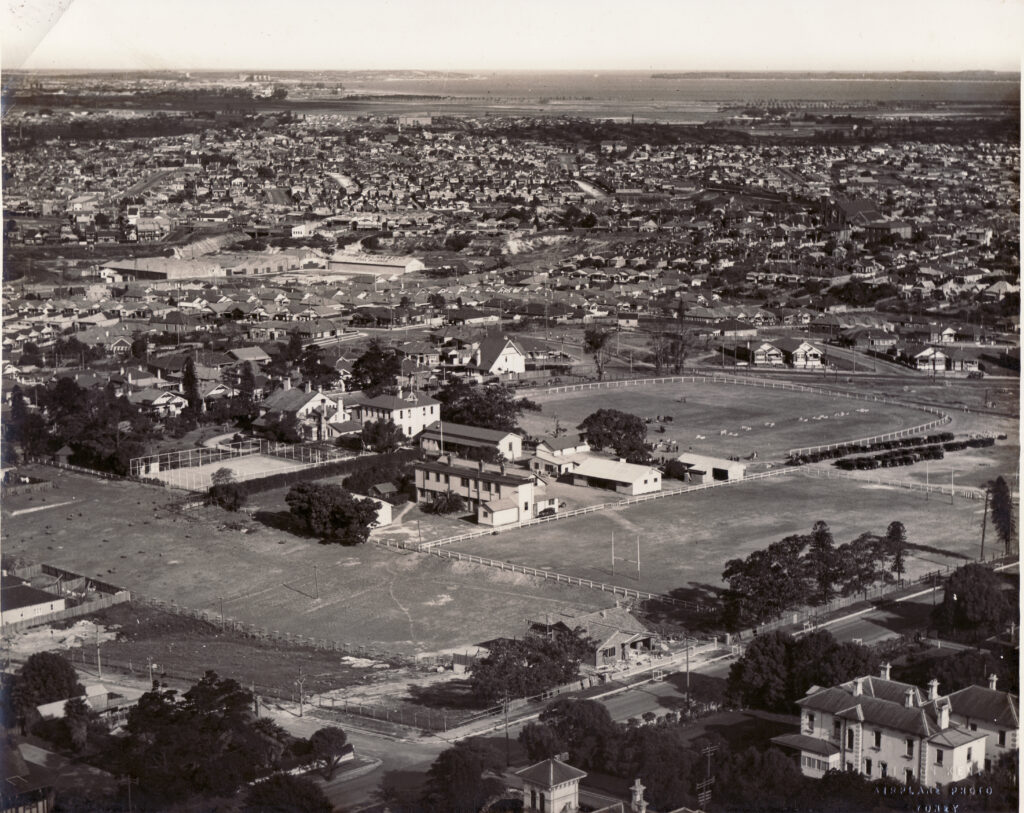
The decade saw many developments that have shaped the city we love today. And, in the heart of Dulwich Hill, where Trinity had established itself, change was also on the horizon.
Founded in 1913, Trinity Grammar School was closely knit with the Parish of Holy Trinity in Dulwich Hill, of which the School’s founder, Rev George Chambers was the Rector. For many years, Trinity operated out of properties in The Boulevarde that served both as School classrooms, boarding dorms, and Rectory.
By the time the 1920s rolled around, the Parish finances had steadily improved, to the point where they could afford a distinct, separate Rectory. It was a big step for the School – the first time it needed to stand on its own feet financially.
The solution? Expansion. Bringing in more enrolments and financial support was the only way Trinity would survive on its own.
The hunt was on for a new location.
Of course, it wasn’t as simple as finding an available piece of land and purchasing it. At such a pivotal moment in Trinity’s history, a clear strategy was essential, one that looked beyond the School’s immediate needs and into the decades – and indeed centuries – still to come.
The dinner that changed Trinity’s history
Trinity Grammar School was not the only school looking to make a change for the future.
Just a hop, skip and a jump away in Summer Hill, Hurlstone Agricultural High School was beginning to consider whether it would have the land to continue agriculturally-centred studies. The Department of Public Instruction (now known as the Department of Education NSW) was considering moving the College right out of Sydney to Glenfield. Today, Glenfield is well within the limits of metropolitan Sydney but, in the early 20s, it was a big leap to move the school this far west.
In 1922, Mr F H J Archer was in his final year as Headmaster at Trinity, and had an opportunity to dine with Mr Longmuir, the Headmaster of Hurlstone Agricultural High School.
It was at this dinner that Hurlstone’s plans to make the move further west came to light. For Mr Archer, hearing this information was the puzzle piece that completed the picture.
If Hurlstone was moving, the land they occupied in Summer Hill would become available.
Mr Archer wasted no time in sharing this new piece of information with the School’s Warden, Rev Chambers.
From there, things snowballed quickly. Rev Chambers saw the “marvellous coincidence of needs”. He saw the opportunity as one in which seeking forgiveness would be easier than asking for permission, and approached the Department alone, without the go-ahead from the School Committee. But, as Mr Phillip Heath reflects in The Daring of Your Name, Rev Chambers had clear eyes, and knew that he wasn’t likely to face much opposition to such a “marriage of convenience.”
Rev Chambers entered into negotiations with the Department to buy Hurlstone College and grounds in exchange for Trinity’s current site, no easy task as Mr C E Latham – a member of staff throughout this period – reflected:
“Never before, I believe, was there such a gamble of faith, and never were the persuasive powers of the Warden needed so much to obtain the necessary signatures of guarantors to this scheme which many thought as nebulous and chaotic as the whirling gaseous ball out of which our planet first took shape. But never was there any doubt in the mind of the Warden that this plan would succeed. Through all that very difficult period, he remained smiling and serene. What a tradition of faith and courage for all Trinitarians to contemplate!”
For the sum of £13,000 (equivalent to almost $1.3 million today), Rev Chambers purchased 17 acres of the Hurlstone site. In doing so, he secured Trinity’s future in Summer Hill.
His gamble had paid off.
A snag in the plan and making do in the meantime
Until the point of sale, everything seemed to fall into place. But, once the sale had been secured things got complicated, fast.
The Department insisted upon reclaiming the properties on The Boulevarde, Dulwich Hill in February 1924, but the Hurlstone site would be withheld until February 1925, leaving a 12-month gap where Trinity would have no home base.
In the end, this interim period was doubled.
Dr G E Weeks was the Headmaster from 1923 to 1928, leading the School throughout this period. In the May 1924 edition of The Triangle, in his ‘Detur Gloria Soli Deo’ missive, Dr Weeks wrote:
“In days to come, Trinity will be known as the Uppingham of New South Wales, and 1924 as the year of the Great Removal … the parting from the old home was not unmingled with regret. The School assembled in the dear dusty old playground and sang ‘O God Our Help in Ages Past’ as, for the last time, the green and white School flag slowly fluttered down.”
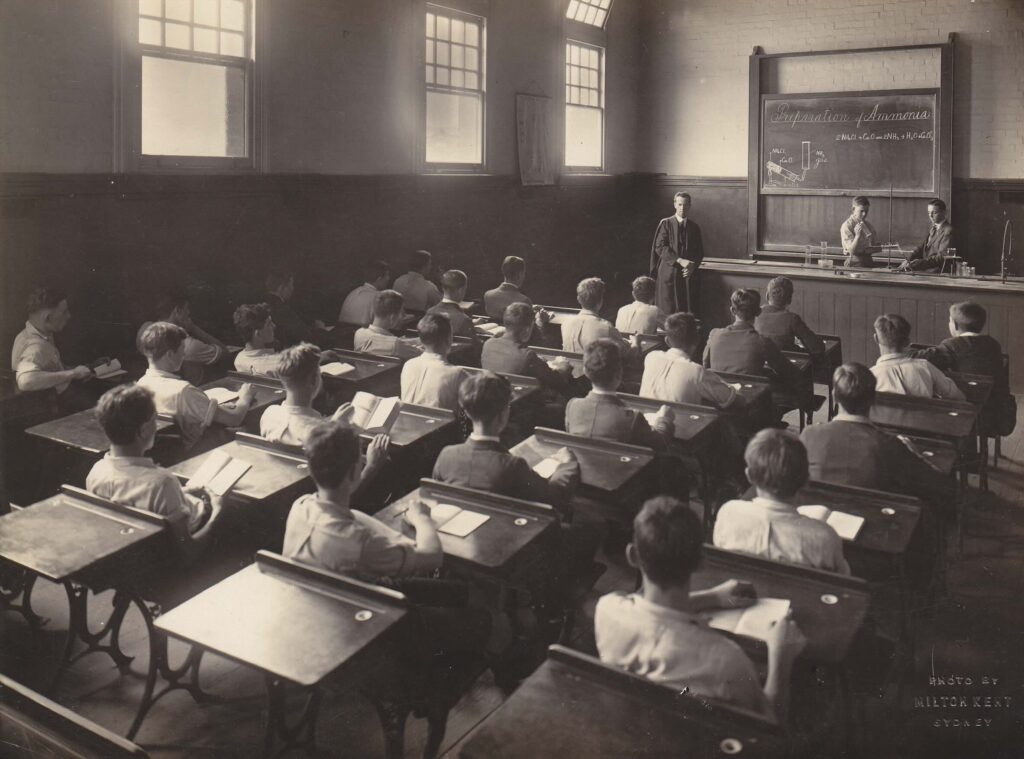
There was a clear vision for Trinity’s future but as they left the ‘old home’, there were many doubts. Staff and students spent two years in Holy Trinity Dulwich Hill’s parish hall, where the makeshift nature of their classrooms was less than ideal.
“Hessian curtains suspended from the ceiling separated one class from another and, if we are to believe one account, Trinity voices, being what they were, allowed an enterprising pupil to choose between a variety of lessons within earshot at any given time.”
The image is almost comical but for the families of students, it seemed as though the promise of a ‘Great Public School’ education was eroding before their eyes.
“Although the younger boys regarded the experience as a reckless adventure, the boys who sought their Leaving Certificate suffered.”
Meanwhile, boarders relocated to ‘Holwood’, the temporary boarding house on Victoria Street opposite the new site and were ferried back to Dulwich Hill each day for lessons … a very different commuting deal than what they had been promised.
It was only the hope for what was to come that fuelled the community.
At the tail end of 1925, when work was able to begin on the Hurlstone site to prepare the buildings fit for Trinity’s purpose, the mood of the community shifted again, restless, full of hope, and ready to embrace the next, now overdue, chapter.
Struggling into the new era
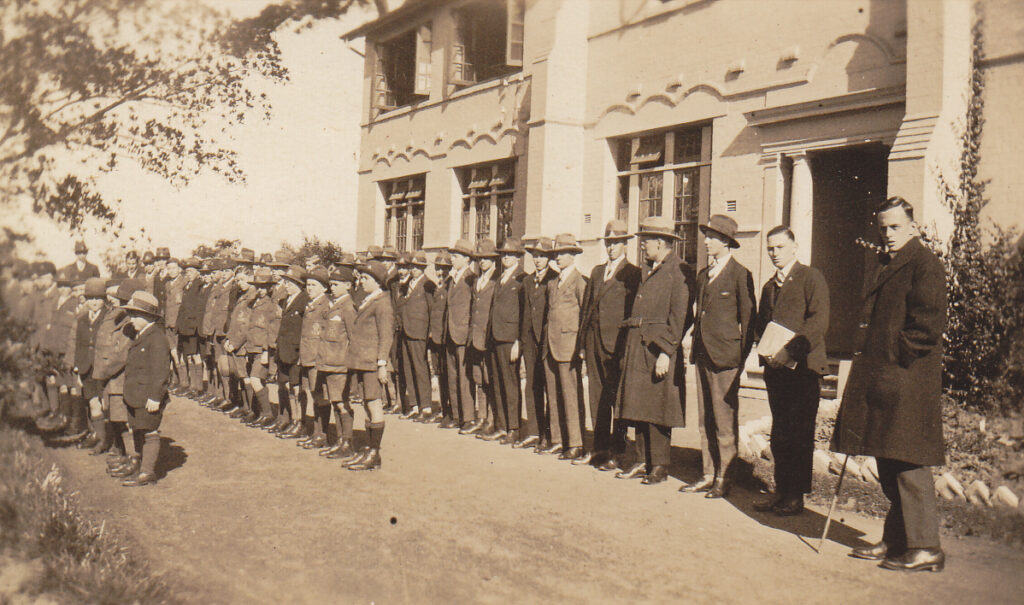
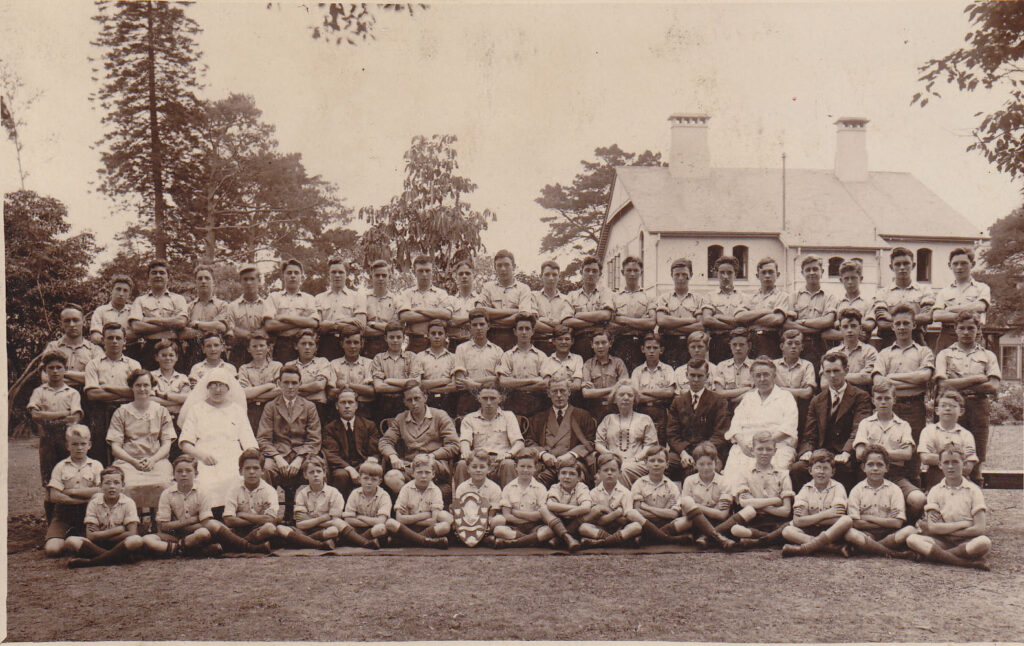
On the 17th April 1926, Trinity officially opened at the Hurlstone site, an occasion that was met with “unabashed joy”.
“‘Your young men shall see visions.’ Such has been the experience of all connected with Trinity who have in any way thought of the future of the School or dreamed of its possibilities. As the School enters into possession of its larger premises … and work will be resumed next term in new classrooms, it is to be remembered that this step makes possible the realisation of the vision of Trinity as a Great Public School.’”
The Governor General, Lord Stonehaven, opened the new Trinity Grammar School in a ceremony where two foundation, memorial stones were placed – one marking the new site and the other brought over from the old Dulwich Hill site, bearing the date of 1917, the date of Trinity’s first building project, the extensions of ‘The Towers’ on The Boulevarde, Dulwich Hill.
At the time, the entire property “consisted of the boarding school block, the Headmaster’s house, a long wooden building which doubled as a chapel, assembly hall, and several classrooms partitioned off from one another, and a fourth building used as the Intermediate room which later became the groundsman’s cottage”.
But, in what has become a trademark for this period in Trinity’s history, the long-awaited occupation of the Hurlstone site had its own problems.
“There was inadequate water supply, the paddocks were largely unusable as ovals, the buildings were not wholly suited to the needs of Trinity and it was hard to find quality staff because of minimal wages.”
The construction of the ovals to become fit for teams to practice – and therefore, perhaps, leading to some success of the School’s sports teams – would take another four years. Wages for staff would remain low with many of the staff, including the Headmaster, taking salary reductions in an attempt to help the School claw its way out of debt.
The next strategy put forward to help with the debt was to increase the Boarding numbers. By June 1926, enrolments were up to 177, including 66 boarders, many of them recruited by Rev Chambers personally as he visited country districts to drum up enrolments. When ‘Holwood’ was sold in 1927, the science room at the Summer Hill site was converted to a two-storey building, with the top floor accommodating the boarders, in addition to the boarders housed adjacent to the Headmaster’s House.
Many of the boarders who had joined Trinity during this time, however, were only interested in a ‘one-off’ experience in a city school and, when the year ended, they returned to the country, leaving a gap in the boarding numbers once again.
And, while the rest of Sydney was enjoying a newly electrified train line, the Inner West was still underserved by public transport – as it still is today – making it harder for students from further flung suburbs to attend Trinity.
“The place was an almost unredeemed cultural wilderness, both physically and otherwise,” remembers Mr Allan M Bryson in a letter to Mr Reg Marsh in 1992.
All the odds were stacked against Trinity with Latham and Nichols describing the combination of pernicious debt, inadequate facilities, geographical factors, and trouble retaining staff as a cocktail that “disadvantaged it in the marketplace of education” and “should have led to the failure of the School.”
“Put simply, by every law of economics, Trinity should simply not exist.”
Indeed, it wasn’t a quandary unique to Trinity, with over 20 independent schools in NSW founded at a similar time to Trinity closing over the next decade or two.

A way out; refined by fire
By the end of 1927, the situation was less than ideal but the now Bishop Chambers was not one to back down and he consequently lobbied for Trinity’s survival with his well-honed knack for raising funds.
“The motivation behind this period of furious activity was Chambers’ personal conviction that one day, probably very soon, Trinity would be a ‘Great School’. He had committed the School to a course of action which would either ‘make or break it’, and he believed its future to be in the hands of the Almighty. Yet Chambers was a pragmatic theologian, no doubt holding to the dictum: ‘Trust in God and keep your powder dry’”
“The period of the Removal was possibly the busiest in Chambers’ normally hectic life. Time and again he pressed ahead when all indications urged moderation and circumspection. He seemed to know nothing of uncertainty or discouragement and those around him found him either simply irresistible or utterly indomitable. Upon his initiative alone, Trinity Grammar School rose from the dusty Dulwich Hill playground to the relative heights and spaces of Summer Hill, leaving sceptics and opponents open-mouthed with astonishment.”
In February 1926, Strathfield Grammar School was bought by Bishop Chambers. Up for sale, the purchase may seem rash in the face of so much existing debt, but the Bishop was looking ahead, intending the school to act as a ‘feeder’ school for Trinity, boosting enrolments, chipping away at that debt. Today – after varying integrations and iterations – this site is now occupied by Trinity’s Preparatory School.
Also in 1927, in April, the Church Property Trust of the Diocese of Sydney took over the trusteeship of the property of Trinity.
And, in Trinity’s now established history of generosity, Bishop Chambers persuaded “one of Sydney’s most prominent philanthropists, W G H Bosch, to donate £10,000, provided an equal amount was raised by the community.” The Bosch Appeal, as it was known, ran until the end of 1930 and eventually raised £22,536 which, with other donations, was enough to make a significant dent in Trinity’s debt.
Along with a change of Headmasters – with Mr Hilliard returning to the position in 1928 – things were changing at the Summer Hill site. Slowly, but surely, “the Hurlstone grounds were becoming ‘Trinity tamed’”.
And, as the facilities improved, so did sporting and academic results. As parents gained faith in the School again, enrolments began to steadily rise too.
Of course, just around the corner was the Great Depression and a harrowing time for Trinity that would see it edging nearer to closure than it ever has before, or since, but as the 20s came to an end, things were looking up.
In the December 1924 edition of The Triangle, School Captain James Laing-Peach reflected on the year gone by. The School had just relocated to their temporary premises in the parish hall and, while they had a great hope in the future, they did not know what was to come.
His words could have been written of Trinity’s contemporary building project and are a reminder of the purpose of such undertakings, as well as Proverbs 19:21. “Many are the plans in a person’s heart, but it is the Lord’s purpose that prevails.”
“Some day in the future, when the dreams of the present have been realised, and Trinity has at last been established as the great school of our visions – with its new grounds and more extensive equipment – we can imagine our descendents looking back on this period, and speaking with proud memory of those daring ones who, by breadth of vision and a faith of the kind that overcomes the world, carried the School through the great and perilous venture of 1924. Then, and perhaps only then, will the real value of this year’s work be apparent.”
This article originally appeared in Issue 1 of Trinity Together which you can
view on our online digital bookshelf.