
Humanity highlighted through history
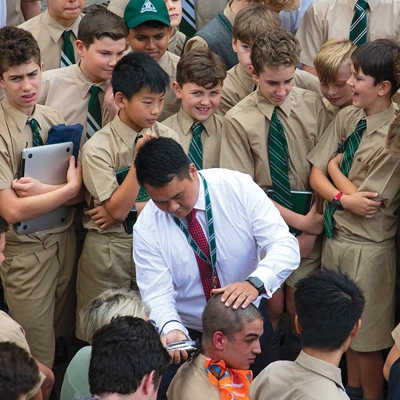
Drawn to Trinity because of the School’s commitment to growing good men, Mr Benjamin Street is now in his fifth year here as a History teacher and Studies of Religion Teacher.

He says History, in particular, is a space where humanity can be examined, allowing students to determine the kinds of people they want to be in the world.
“We look at what it means to be a good person … why do we see certain people as heroes and others not? It’s about getting boys to understand their world.”
It’s not uncommon for Mr Street to come up against questions about the perceived relevance of studying History.
“We always hear ‘It’s about the past … how is it preparing us for the future and getting a job?’ but it’s about the bigger picture.”
Through his work, he wants to push against the idea that education is about the ‘end goal’ of securing a job.
“We’re not just making the next office managers or engineers. How can we get boys to really think? We know they can do it – it’s not a question of ability – but how can we get them to take initiative in their own lives to really critically think about what they are learning?”

It is this line of thinking that inspired him to take on the International Boys’ School Coalition (IBSC) Action Research program for 2026/2027.
His cohort’s focus topic is ‘Future Frontiers: Fostering Boys’ Learning in the Forward-Thinking Classroom’. With such a topic, Mr Street was expecting plenty of his peers to be looking at AI and its implications in the classroom, but discussions took a slightly different turn.
Rather than focusing on the technology itself, there’s a shift to focusing on what it will take for students to thrive in a world where AI completely changes the narrative.
“Many of us are focusing on the ‘soft skills’ that students need to step into a world where our humanity is highly valued,” he says. “Spaces like the care profession where boys are already underrepresented – are we preparing them in this way?”
His own Action Research project will consider the question: ‘How do reflective thinking logs enhance critical thinking dispositions of Year 9 boys?’

Each year, Year 9 students undertake a historical inquiry project where they investigate any part of the past they’re interested in. Throughout this process, Mr Street will be providing structured reflective logs with the hope that it will see students transforming their approach to how they engage with history and develop their critical thinking disposition.
While he stands at the very beginning of this project, Mr Street says he’s excited to see where the research leads him and to use the experience at this year’s IBSC Conference as a firm foundation to begin.
“I love history. I would have every person ever study history if I could. I think it makes a better person of everyone, but I also know that it’s not everyone’s cup of tea.
“It’s more than just dates and times and names. I want to find a way to encourage boys to critically think, not just because I tell them to, but take that nature in themselves. If it helps me and my faculty to know how to do that better, it will be worth it, and if I can share what I learn with other educators around the world, that’s even better.”
You can read more about the IBSC Conference and Ms Mikaela Janes’ Action Research here.